Lake Louise in Winter
From November to April the lake is a sheet of ice under the Victoria Glacier, parking is free, the crowds are gone, and the ski hill across the valley runs into May. Here is what is open, what it costs, and what to wear.
Updated Mountain Time.
Conditions on the mountain today
6.9°C at the station right now
This page describes the coming winter, which runs November to April. The reading above is today's summer number from the Environment Canada station of record. The first lasting snow usually arrives with the November cold.
What is open in winter and what is closed
The Chateau, the ski resort, the village and the lakeshore itself stay open all winter; Moraine Lake, the teahouses, the canoes and the Parks Canada shuttles are closed until late spring. Winter here is not a shutdown season the way it is in some mountain towns. It is a second, quieter season with its own set of things that work.
| Fairmont Chateau, restaurants and the rink | open all winter |
|---|---|
| Lake Louise Ski Resort | 6 Nov 2026 to 2 May 2027 |
| Village shops and fuel at Samson Mall | open year round |
| Lakeshore trail and designated winter trails | open, snow-packed |
| Moraine Lake Road | closed to vehicles, ski trail only |
| Parks Canada shuttles | 15 May to 12 October 2026 |
| Lake Agnes and Plain of Six Glaciers teahouses | closed for winter |
| Lakeshore paid parking | free outside 15 May 2026 to 12 October 2026 |
The closure that surprises people is Moraine Lake. The road is gated shut to vehicles for the whole winter, Parks Canada tracksets it as a cross-country ski trail, and the lake at the end sits in serious avalanche terrain. There is no winter version of the Moraine Lake photograph without backcountry skills and avalanche gear, so plan it for summer and let it go.
The high trails above Lake Louise close in a quieter way. Parks Canada is blunt that from November through June not every sign-posted destination is safe to travel, because summer hiking routes cross avalanche paths that do not look like anything from below. In winter you pick from the designated winter trails, which are listed further down this page, and you get a genuinely good day out of them.
Set one expectation straight before you book: the lake is white in winter, not turquoise. The famous colour comes from glacial rock flour suspended in meltwater, and from freeze-up until the ice clears in late May or early June the lake is a snow-covered plain with mountains around it. That is its own kind of spectacular — a frozen lake you can stand in the middle of, under the same glacier — but people who arrive in December expecting the July photograph go home disappointed, and nobody warned them. Consider yourself warned, and come for what winter actually offers.
A note on December specifically, since so many people ask about it: it is the darkest month, with barely eight hours of daylight and the sun low even at noon, and on the normals it is the coldest month at the village station. It is also the month the Chateau dresses for Christmas, the ski hill builds toward full operation, and the lake is reliably frozen. It is a moody, quiet, genuinely wintry time to be here — just plan your days around the light, because at four in the afternoon it is gone.
One thing does not close: the park entry fee. You still need a pass in winter, at $12.25 a day for an adult or $24.50 for a family or group, even though the parking machines sleep until spring.
Skating, sleigh rides and the ice castle
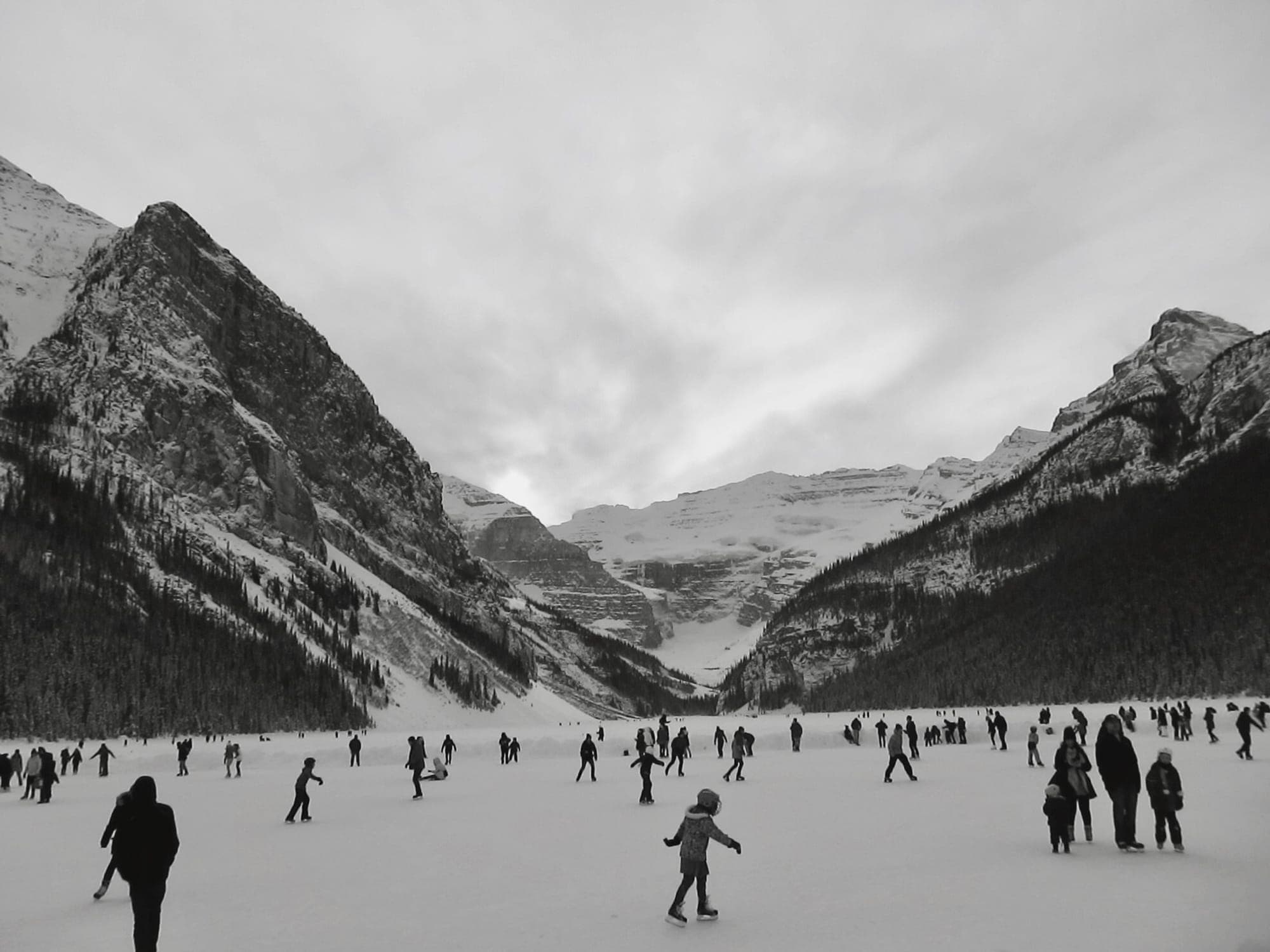
The Fairmont clears and maintains a skating rink on the frozen lake directly in front of the hotel, Brewster Adventures runs horse-drawn sleighs along the lakeshore trail, and in the heart of the season an ice castle stands on the ice. This is the winter postcard, and unlike the summer postcard you do not have to fight anyone for it.
The rink is the real thing: lake ice, cleared of snow, with the Victoria Glacier as the far wall. Skate rentals are at Chateau Ski & Snow inside the hotel, which closes each summer and reopens for the 2026–27 season. The hotel has not published exact rink dates or prices, so check its winter guide close to your trip; broadly, the rink runs through the core of winter for as long as the ice holds. There is an ice bar on the lakeshore pouring mulled wine on winter evenings.
Stay on the maintained rink unless you know exactly what you are doing. Parks Canada does not monitor natural ice anywhere in the park, and its guidance is 15 cm of ice for walking or skating alone and 20 cm for groups. Early-season black ice photographs beautifully and drowns people. The rink exists so that you do not have to make that judgement.
The sleighs are run by Brewster Adventures, the long-time horse outfit at the lake, with daytime rides toward the frozen waterfall at the back of the lake and evening rides back toward the lit-up Chateau. Book directly with them; they publish dates and prices, and rides fill around holidays.
If you can aim your trip at late January, do. The SnowDays festival runs 21 January to 7 February 2027 across Banff and Lake Louise, and its Ice Magic carving events put professional ice sculptors and their finished work on the lakeshore from 3 to 7 February 2027. The ice castle and sculptures usually stand for weeks afterwards, weather permitting. There is a longer guide to all of this on the skating page.

Snowshoeing and cross-country trails
Parks Canada tracksets a proper network of cross-country ski trails around the village, and the easiest snowshoe walk in the area is straight down the middle of the frozen lake on the lakeshore trail. None of it needs a guide, a ticket or a reservation — just daylight and the right clothes.
| Moraine Lake Road, double trackset | 8.9 km one way |
|---|---|
| Great Divide, double trackset | 9.8 km one way |
| Tramline, new route | 4.3 km one way |
| Bow River Loop, dogs on leash allowed | 7 km loop |
| Fairview, ski only | 4.2 km one way |
Moraine Lake Road and the Great Divide are the two classics. Both are wide, double-trackset with a skating lane, and gentle enough for a first day on skinny skis — the Great Divide trends slightly downhill the whole way out. On Moraine Lake Road, turn around at the viewpoint: Parks Canada warns that beyond it the road crosses large avalanche paths.
For snowshoes and winter boots, the lakeshore trail from the front of the Chateau runs 2.3 km to the back of the lake, where a frozen waterfall hangs off the headwall and ice climbers pick away at it. Do not continue past the end of the lake — Parks Canada flags the ground beyond it as dangerous avalanche terrain. Fairview Lookout (1.2 km up through the trees to a view over the frozen lake and the hotel) and Louise Creek (2.9 km) are the other short options; go up and back on Fairview rather than looping, because the loop crosses avalanche terrain too.
If the weather at the lake turns hostile, drop to the valley floor. The Bow River Loop is a flat 7 km circuit through the trees along the river at village level, single trackset, and it is the one trail in the network where dogs are allowed on leash. You can start it from four places — the Station Restaurant, the campground kiosk, the Post Hotel or Samson Mall — which in practice means you can ski or walk straight from the village without moving the car. It is several degrees kinder down there on a cold, windy day, and it is where the locals go when the lakeshore is a wind tunnel.
Two small practicalities. Packed snow turns to ice on the busy stretches, so ice cleats that slip over your boots earn their space in a pocket. And check the trail report on the conditions page the morning you go — grooming and closures change with the weather.
The ski hill in one page
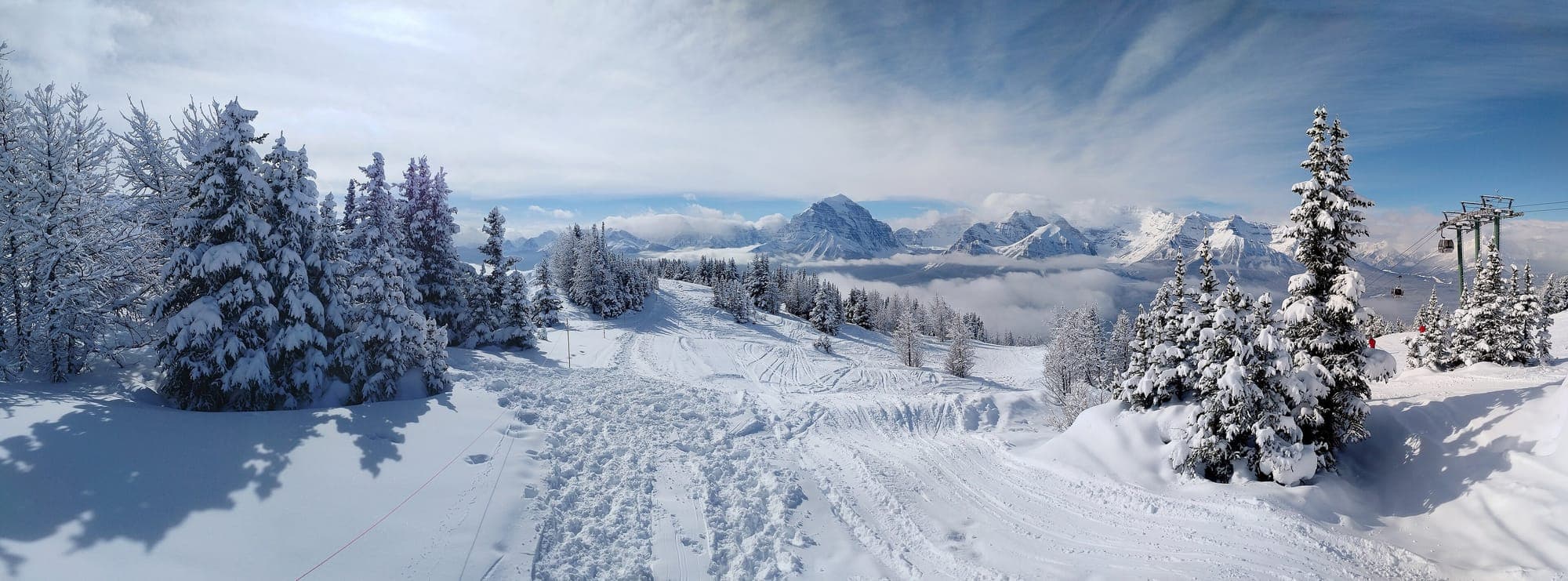
Lake Louise Ski Resort is one of the largest ski areas in North America — over 4,200 skiable acres, 170 runs and 13 lifts across several mountain faces — and its 2026–27 season runs 6 November 2026 to 2 May 2027. That is nearly six months, and in strong snow years it opens early: the 2025–26 season started on 4 November.
The honest one-paragraph read: the front side is long groomed cruising with the Victoria Glacier country filling the horizon, the back bowls are the famous part and hold genuinely serious terrain, and the resort’s own split is roughly 25% beginner, 45% intermediate and 30% advanced, so a mixed group all finds a day here. It sits on Whitehorn Road across the Trans-Canada from the village — the same place as the summer Park and Ride — about fifteen minutes from the lakeshore, so people routinely ski the morning and skate the afternoon.
The shape of the season matters more than the dates. November is real skiing but limited skiing: the resort opens on a machine-made ribbon and a handful of lifts — in 2025 it opened early, on 4 November, with one chair and one run — and the terrain builds through December as the natural snow arrives. The heart of the season is January to March. April into early May is the sleeper: full snowpack up high, spring sun, empty weekdays, and the lake below still locked under ice while the parking lots down south fill with golfers. If your dream is the back bowls, aim for February or March, not opening week.
Getting there is its own page: the ski shuttles from Banff, parking at the hill, and where to rent. For tickets, hours, lift status and the snow report, go straight to skilouise.com. Prices change through the season and the resort’s site is the only current source, so this page deliberately does not quote a lift ticket number that would be wrong by the time you read it.

Driving up in winter, and when not to
The Trans-Canada and Lake Louise Drive are plowed all winter, and on a clear day the drive up from the village is straightforward in any car on winter tires. The road up to the lake climbs the whole way, though, and it is the climb that sorts out all-season tires from real winter ones. If you are renting a car for a winter trip, ask for winter tires when you book, not at the counter.
Budget honest travel times. Lake Louise is about 184 km — roughly two hours — west of Calgary on the Trans-Canada, and about 60 km, or forty minutes, west of Banff. Those are the resort's own dry-road numbers; on a snowy day, treat them as a floor and add half again. The stretch to watch is the Castle Junction to Lake Louise section, which climbs, drifts, and holds ice in the tree shadows long after the rest of the highway is bare.
When not to drive is the more useful question. During and immediately after a big snowfall, the highway between Banff and Lake Louise gets slow, rutted and occasionally closed while the plows work; give it a few hours rather than joining the line of cars in the ditch. In a deep cold snap the road itself is usually fine but everything else gets harder — batteries, rubber, and people. And in the short days of December, when the sun is up for barely eight hours, plan to do your driving in daylight.
Before leaving Banff or Calgary, look at the live highway cameras and the 511 Alberta report on the road conditions page — thirty seconds of looking at actual pavement beats any forecast. Carry the boring kit Parks Canada recommends for winter travel: warm clothes in the car, a shovel and a bag of sand or traction aids, food and a full tank. The hazards it lists for the park in winter — avalanches, thin ice, disorientation, hypothermia, frostbite — are all managed by the same two habits: check conditions before you go, and stay on the designated winter trails.
And to say it once more: do not put Moraine Lake in the winter itinerary. The road is closed to vehicles from mid-October until close to June, and no, there is no side way in.
What to wear at minus thirty
Dress for the climate normals, not the brochure: at the Lake Louise station the January daily low averages −18.4 °C, December averages −19.1 °C at night, and the recorded extreme is −52.8 °C. Minus thirty is not the daily state of affairs, but it visits most winters, and the difference between a magical day and a miserable one is entirely in the bag you packed.
| November, daily high / low | −1.7 °C / −12.6 °C |
|---|---|
| December, daily high / low | −6.9 °C / −19.1 °C |
| January, daily high / low | −5.4 °C / −18.4 °C |
| February, daily high / low | −1.7 °C / −17.6 °C |
| March, daily high / low | 2.9 °C / −12.3 °C |
The kit that works: a base layer that is not cotton, a warm mid layer, and a real insulated parka — the kind that feels like overkill in the shop. Insulated winter boots with room for thick socks, because standing on lake ice pulls heat out through your soles faster than air ever will. Mitts over gloves, a toque that covers your ears, and a buff or scarf for your face on the cold days. Chemical hand warmers cost little and rescue a lot, especially inside camera gloves — phone and camera batteries die fast in the cold, so keep spares in an inside pocket.
Two local notes. First, the cold here is dry, which genuinely does make −15 °C feel more civil than the same number in a damp climate — but it also means you dehydrate without noticing, so drink water. Second, the normals above also show the other side of a Rockies winter: February afternoons average close to freezing, and March goes above it. Warm spells roll through most winters, so pack sunglasses and sunscreen along with the parka. Snow at this altitude reflects enough light to burn you in January.
The winning rhythm with kids, or with anyone, is the Chateau’s own: forty-five minutes on the ice, then hot chocolate indoors, then out again. Nobody toughs out a whole day at −25 °C, and nobody needs to — the rink is thirty steps from a heated lobby.
Winter parking and shuttle differences
Between 12 October 2026 and 15 May 2026, lakeshore parking is free and the Parks Canada shuttle does not run at all — the two facts that make a winter visit logistically the opposite of a summer one. There is no reservation to win, no $42 fee at the machine, and no 4:30 am alarm. You drive up Lake Louise Drive and park at the lake like it is 1995.
The shuttle season is 15 May to 12 October 2026, and the Park and Ride at the ski resort reverts to being the ski resort’s own parking for the winter. The only public transit to the village in winter is Roam Transit’s route 8X from Banff — check its current winter schedule before you build a day around it, because it is a handful of departures, not a shuttle loop.
Free does not always mean empty. The lakeshore lot still fills on the days everyone has the same idea: the Christmas-to-New-Year week, ski holiday weekends, and the Ice Magic weekends in late January and early February. On those days, arriving before mid-morning or after mid-afternoon keeps it painless — a far gentler ask than the summer sunrise race. The rest of the season, you will park without thinking about it.
Everything else about the money is on the parking page, but the short version for winter: bring a park pass ($12.25 a day per adult, free for anyone 17 and under), and spend what you saved on parking at the ice bar.
Common questions
Is Lake Louise worth visiting in winter?
Is the lake frozen in December?
Do you need a shuttle reservation in winter?
How cold does Lake Louise get?
Winter facts on this page come from the operators directly: Parks Canada's cross-country ski trails, snowshoe trails, winter safety and Lake Louise and Moraine Lake pages; the Lake Louise Ski Resort season dates; the Fairmont Chateau Lake Louise winter guide; Banff & Lake Louise Tourism's SnowDays listings; and Environment and Climate Change Canada's climate normals for the Lake Louise station. Last checked 12 August 2026.