Lake Louise History
This valley was named, travelled and used for thousands of years before a railway surveyor was shown the lake in 1882. The timeline starts where the history starts.
Updated Mountain Time.
Since time immemorial
The Nations of this valley
Parks Canada states that the lands and waters of Banff “have been used for millennia by Indigenous Peoples for sustenance, ceremony, trade and travel”, and that the park lies within the present-day territories of Treaty 6, 7 and 8 First Nations and the Métis Homeland.
The Nations it names in connection with this park are the Bearspaw, Chiniki and Goodstoney First Nations, who together form the Stoney Nakoda, or Îyârhe Nakoda, meaning People of the Mountains; the Siksika, Kainai and Piikani Nations of the Blackfoot Confederacy; the Tsuut’ina Nation; and the Rocky View Métis District of the Otipemisiwak Métis Government. The Ktunaxa, the Secwépemc and the Cree used these valleys as well.
This was not one people’s corridor. It was a crossroads, and the passes either side of Lake Louise are the reason. The three Stoney Nakoda Nations remain distinct today, each with its own membership and its own elected Chief and council.
Source: Parks Canada, Indigenous connections, Banff National Park
Long before 1882
Horâ Juthin Îmne, the Lake of the Little Fishes
The Stoney Nakoda name for this lake is Horâ Juthin Îmne, usually translated as the Lake of the Little Fishes.
It is a working name, and it is accurate. The lake is fed by glacial meltwater, it is cold all year and it carries very little for a fish to eat, so the fish in it stay small. A name that tells you what you will catch is a name made by people who came here often enough to know.
The name is recorded in the Dictionary of Canadian Biography, in the account of the man who later took the credit for finding the lake.
Source: Dictionary of Canadian Biography, Thomas Edmonds Wilson
22 September 1877
Treaty 7 at Blackfoot Crossing
Treaty 7 was made at Blackfoot Crossing on the Bow River, well east of here. The Stoney Nakoda accepted it under Chiefs Jacob Bearspaw, John Chiniki and Jacob Goodstoney, and the three Nations still carry those names.
The treaty set out reserves and promised annual payments and continued hunting rights, in exchange for the Nations ceding rights to their traditional territory. What that meant in this valley became clear over the following forty years.
Summer 1882
Edwin Hunter takes Tom Wilson to the lake
Tom Wilson was working for the Canadian Pacific Railway survey and was camped at the mouth of the Pipestone River. He heard the sound of avalanches and asked a Stoney Nakoda man, Edwin Hunter, known as Goldseeker, to lead him to their source.
Hunter told him the sound came from near “the Lake of the Little Fishes”, and took him there. That account is not ours. It is the one recorded in the Dictionary of Canadian Biography, in Wilson’s own entry.
Wilson is still the name attached to the “discovery” of Lake Louise. He was shown it, by a man who already knew where it was and what it was called.
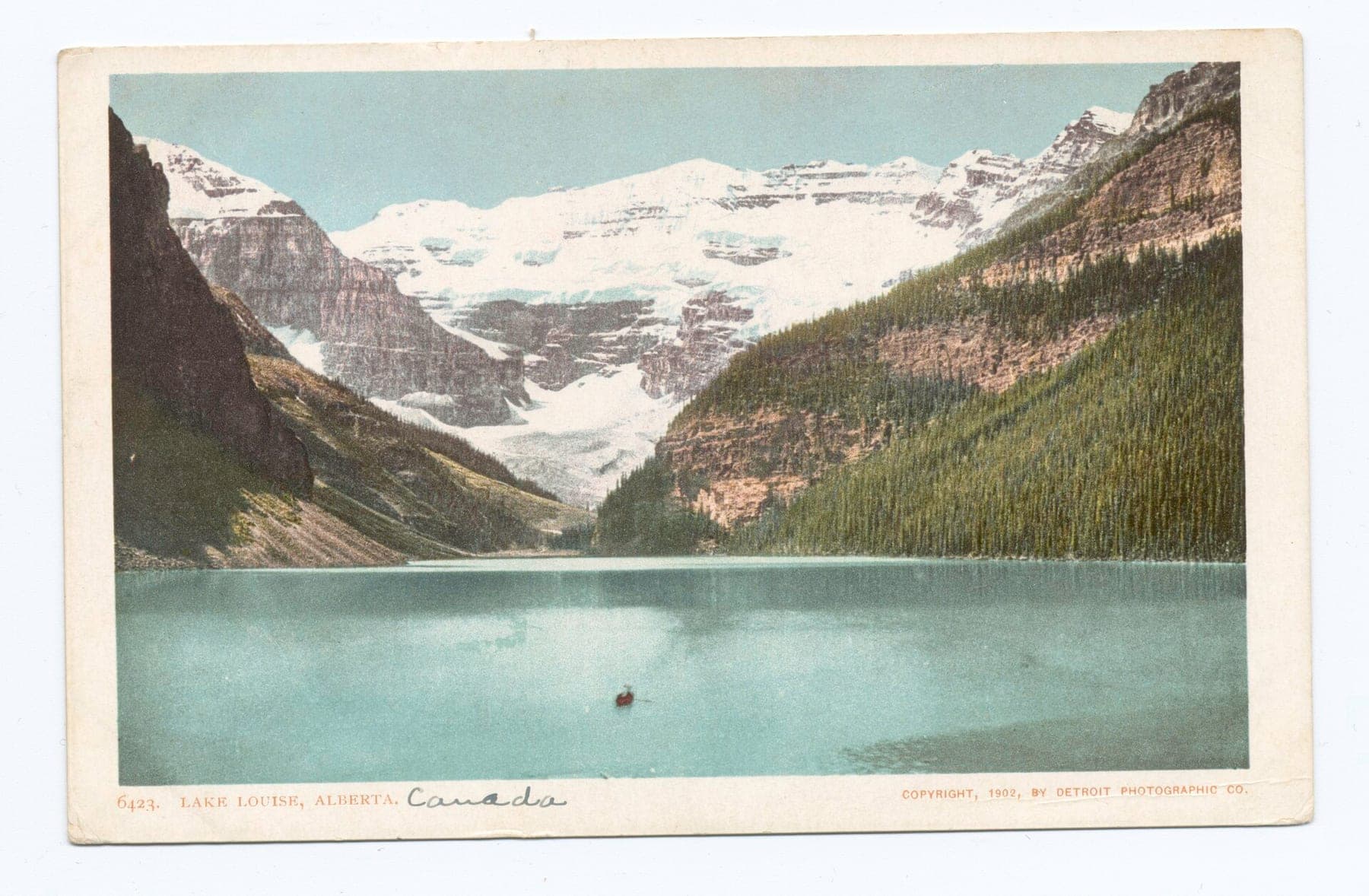
Lake Louise from the first chalet, on a postcard issued about 1902Photo by Detroit Publishing Company, Public domain. Source: Dictionary of Canadian Biography, Thomas Edmonds Wilson
1884
The lake is renamed
Wilson called it Emerald Lake. Two years later it was renamed for Princess Louise Caroline Alberta, a daughter of Queen Victoria and the wife of the Governor General of the day. The province took her name too.
So the lake carries the name of a woman who never saw it, and the older name, the one that describes the water itself, came off the map.
Source: Dictionary of Canadian Biography, Thomas Edmonds Wilson
1885
The park is created
Canada set aside the reserve that became Banff National Park, the country’s first. The Canadian Pacific Railway built to bring passengers to the view, and a chalet went up on the lakeshore.
The railway did not only carry people here. It advertised the place and printed the postcards, and it put its own name on the back of them. Several of the photographs on this page were sold that way.
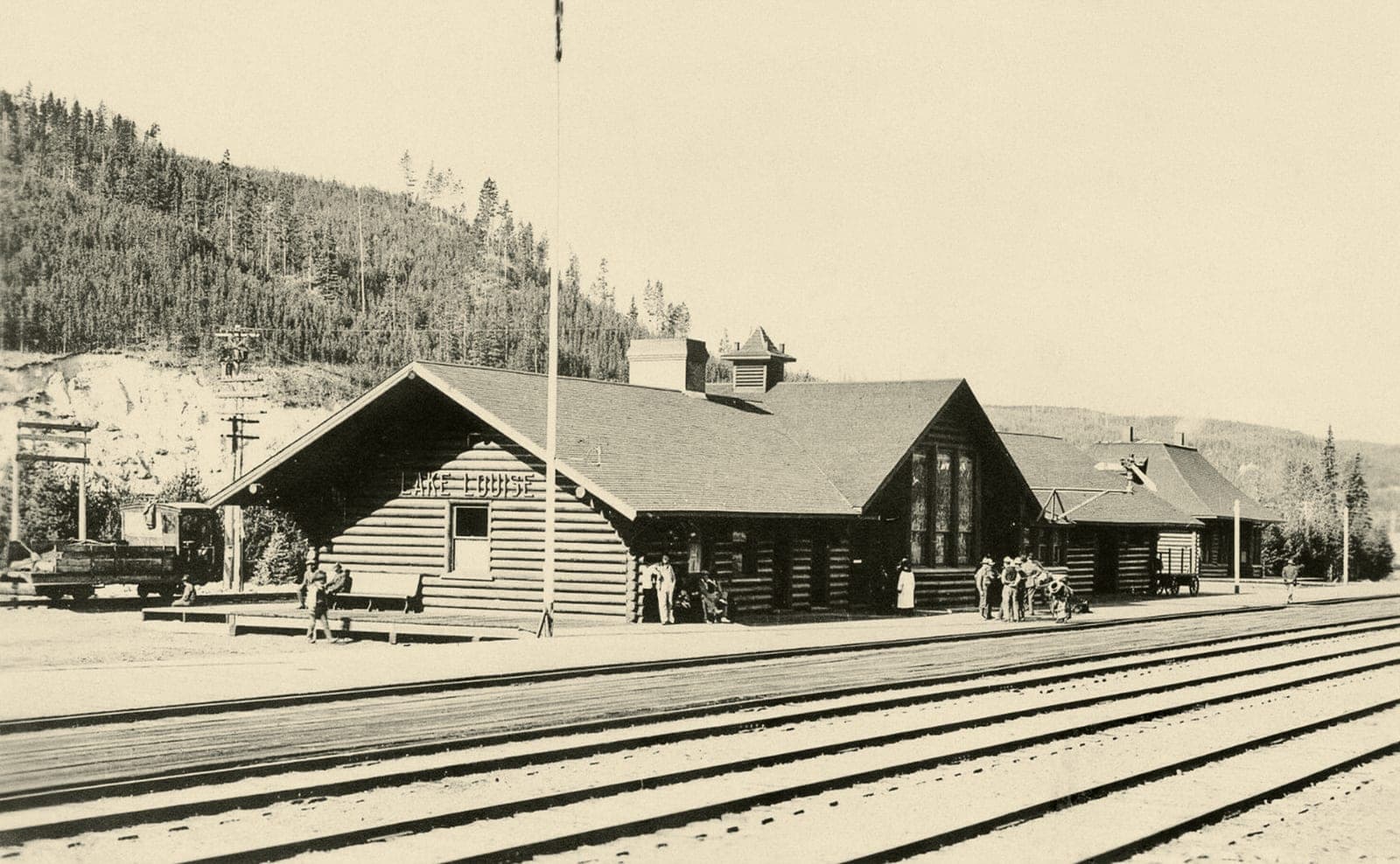
The Canadian Pacific Railway station at Lake Louise, about 1910Photo by Byron Harmon, Banff, Canada, Public domain. Source: Parks Canada, Indigenous connections, Banff National Park
1890 to 1920
The Stoney are excluded from the park
Over these thirty years the Stoney Nakoda were removed from the park that had been made around their territory. This is documented in peer-reviewed history rather than inferred: Ted Binnema and Melanie Niemi set out the case in Environmental History in 2006.
Their finding matters, because it contradicts the story usually told. The removal was not mainly about keeping the place pristine. They argue it was done to conserve game for the benefit of visiting sport hunters.
A place that had been travelled and used for millennia became a place people needed permission to enter, and the permission was not given to the people who had always been here.
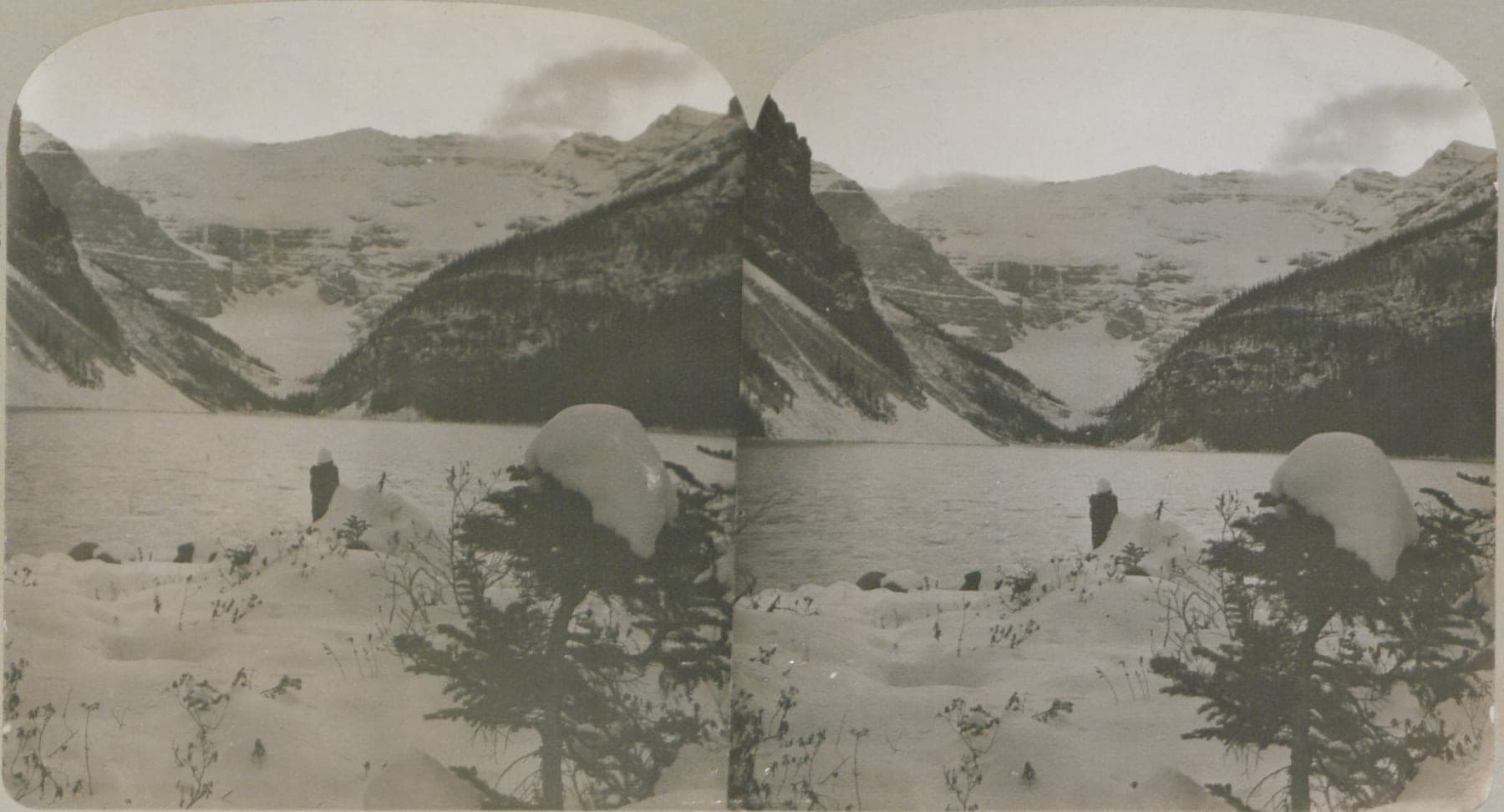
Lake Louise in winter, photographed by Byron Harmon in 1908Photo by Byron Harmon, Public domain. Source: Binnema and Niemi, 'Let the Line be Drawn Now', Environmental History 11:4 (2006), 724-750
1900s onward
The chalet becomes a hotel
The chalet by the lake grew, burned, was rebuilt and grew again into the hotel standing there now. Byron Harmon ran a photography studio in Banff and spent thirty years photographing these mountains, and his postcards carried the view across the country.
Everything a modern visitor complains about here, the car park full before dawn, the queue on the tea house trail, the shuttle booking, follows from the decision to sell this view to as many people as possible.
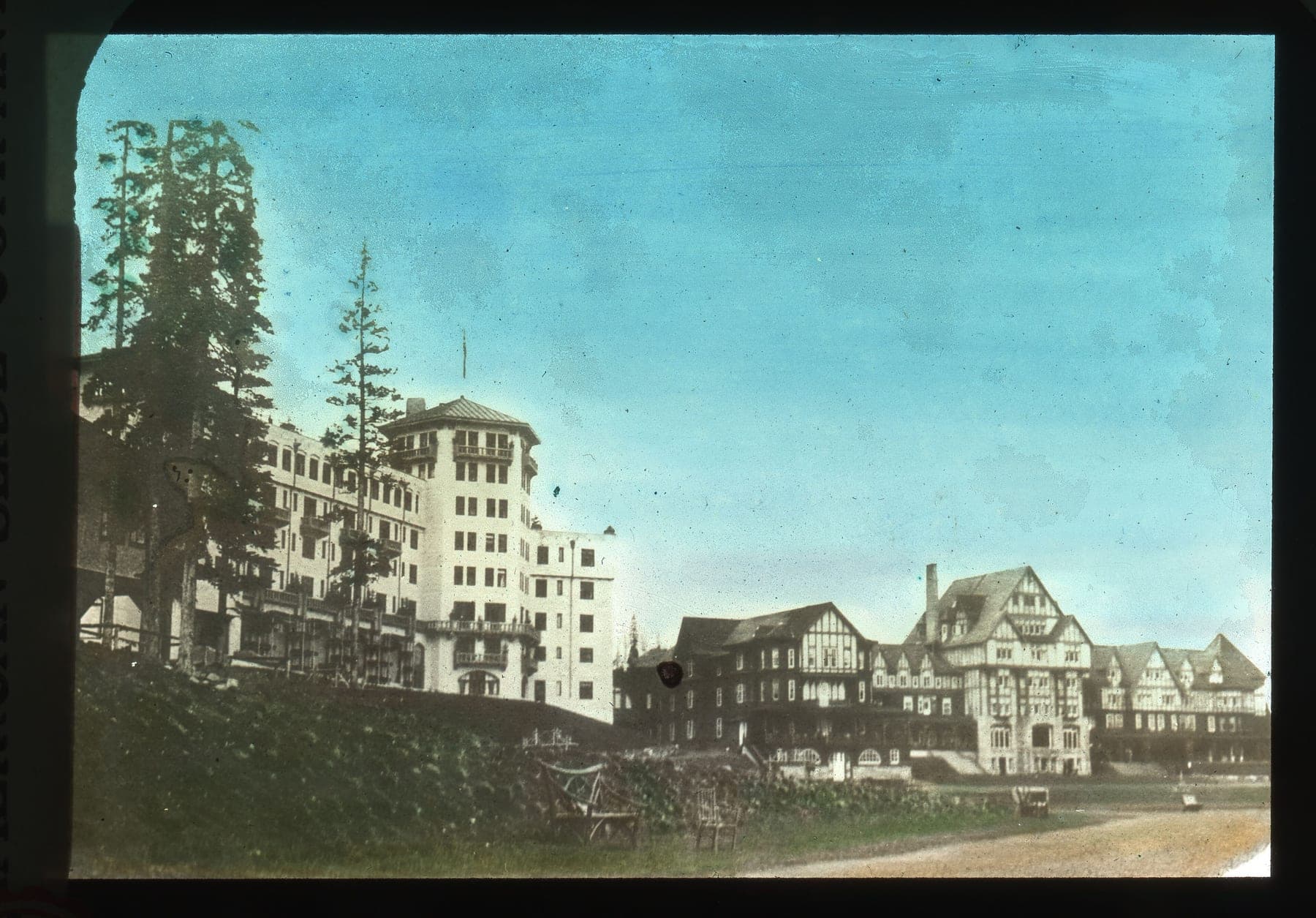
The Chateau on the lakeshore, photographed by a visiting traveller in 1920Photo by Edmund F. Arras, Public domain. Source: Whyte Museum of the Canadian Rockies, Tom Wilson family fonds
2016
The Siksika claim at Castle Mountain is settled
The Siksika Nation and Canada settled a claim concerning a 26.5 square mile timber limit in the Castle Mountain area, known to the Siksika as Miistukskoowa. The area remains part of the park, with specific provisions for Siksika ceremonial and educational use.
Lands within Banff have been, and still are, the subject of land and title claims by several Nations.
Source: Parks Canada, Indigenous connections, Banff National Park
2018 to now
The Indigenous Advisory Circle
Parks Canada established an Indigenous Advisory Circle for Banff in 2018, and now holds cultural use agreements and access arrangements with Nations connected to the park.
It describes the work as strengthening connections to traditionally used lands and waters, and expanding how Indigenous histories and cultures are presented in the park. That work is ongoing rather than finished.
Source: Parks Canada, Indigenous connections, Banff National Park

.jpg)

Common questions
Whose traditional territory is Lake Louise on?
What is the Indigenous name for Lake Louise?
Who really found Lake Louise?
Who was Lake Louise named after?
Were Indigenous people removed from Banff National Park?
Sources
Every entry above names where it came from. Nothing on this page rests on a travel blog or on us.
- Parks Canada, Indigenous connections, Banff National Park
- Stoney Nakoda Nations
- The Canadian Encyclopedia, Treaty 7
- Dictionary of Canadian Biography, Thomas Edmonds Wilson
- Binnema and Niemi, 'Let the Line be Drawn Now', Environmental History 11:4 (2006), 724-750
- Whyte Museum of the Canadian Rockies, Tom Wilson family fonds
Checked 2026-08-11.
Tell us if we have this wrong
If you are from one of these Nations and something on this page is wrong, missing, or badly put, write to hello@lakelouise.net and we will change it. We are not asking anyone to endorse this page. We would rather be corrected than be repeated.