The Best Time to Visit Lake Louise, Month by Month
The short version: early September for most people, July and August for peak colour if you can face the crowds, deep winter for the frozen lake. Here is every month compared honestly.
Updated Mountain Time.
The lake right now
Open water
The lake is normally open water and at its strongest colour, fed by glacial meltwater. For what is actually happening today — weather, roads, cameras — see the conditions page.
The short answer
For most people the best time to visit Lake Louise is the first half of September, and the second-best is late June. In early September the lake is still fully turquoise, every trail and tea house is open, the alpine is snow-free, and the crowds — while real — run noticeably below the July and August peak on weekdays. Late June gets you the arriving colour and long daylight before the school-holiday wave lands.
If the postcard colour is the whole point, come in July or August. The turquoise is at full strength, the daytime highs sit around twenty degrees, and everything is open. The price is the busiest ground in the Canadian Rockies: Parks Canada says plainly that from May through October Lake Louise and Moraine Lake are extremely busy, and that the parking lots fill before sunrise and stay full until sunset.
If you want the other Lake Louise — frozen white, with a skating rink cleared on the ice below the Chateau — come between late December and March. And if your dates land in late April, May before the long weekend, or November, go in with honest expectations: those are the in-between months, when the lake is neither white nor blue and much of the valley is closed or half-thawed.
Lake Louise month by month: weather, ice, crowds, what is open
One month at Lake Louise does not resemble the next, so here is the whole year in one table. The temperatures are the official 1981 to 2010 climate normals for the Lake Louise station, from Environment and Climate Change Canada, rounded to the nearest degree. The crowd notes follow the busy periods Parks Canada itself names.
| Month | High / Low | The lake | Crowds | What is open |
|---|---|---|---|---|
| January | -5° / -18° | Frozen white, rink cleared | Quiet, except New Year week and Ice Magic weekends | Ski hill, skating, snowshoeing. Parking free |
| February | -2° / -18° | Frozen hard | Quiet. Family Day weekend is busy | Ski hill, skating. Parking free |
| March | 3° / -12° | Frozen, snow still deep | Quiet | Ski hill, skating. Parking free |
| April | 8° / -6° | Ice rotting. Stay off it | Quiet. Easter weekend is busy | Ski hill late season, rink to mid-month. Parking free |
| May | 13° / -1° | Ice breaks up late in the month. Not yet turquoise | Building. Busy from the Victoria Day weekend | Paid parking and shuttles from 15 May, tea houses open. High trails snowbound |
| June | 17° / 3° | Open water, turquoise arriving | Busy | Moraine shuttle from 1 June, gondola, canoes mid-month. Alpine trails from late June |
| July | 20° / 5° | Peak turquoise | Packed. Lot full by sunrise | Everything |
| August | 20° / 4° | Peak turquoise | Packed. Lot full by sunrise | Everything. Wildfire smoke possible |
| September | 15° / -1° | Turquoise, softening late in the month | Busy. Larch weekends are packed | Everything. Larches turn mid-month |
| October | 7° / -5° | Colour fades, first lasting snow | Busy to Thanksgiving, then quiet | Shuttles and tea houses end mid-month. Parking free from 13 October |
| November | -2° / -13° | Skinning over. Ice unsafe | Quietest month of the year | Ski hill opens, little else. Parking free |
| December | -7° / -19° | Freezing. Rink in from mid-month | Quiet until Boxing Day, then busy to New Year | Ski hill, skating, the ice castle late in the month. Parking free |
Two patterns in that table are worth pulling out. First, the warm months and the turquoise months are the same months, because the colour is carried in by meltwater — so there is no secret warm-and-empty window. Second, the two shoulder gaps trap people every year. In May the postcards say turquoise but the lake is grey and half-thawed until the final week or so; in November nothing is open, the days are short, and the lake is skinned with ice too thin to walk on. November is also the snowiest month of the year here, with more snowfall in the normals than any other. For the running forecast and a longer view of each month, see the weather page.

When the lake turns turquoise
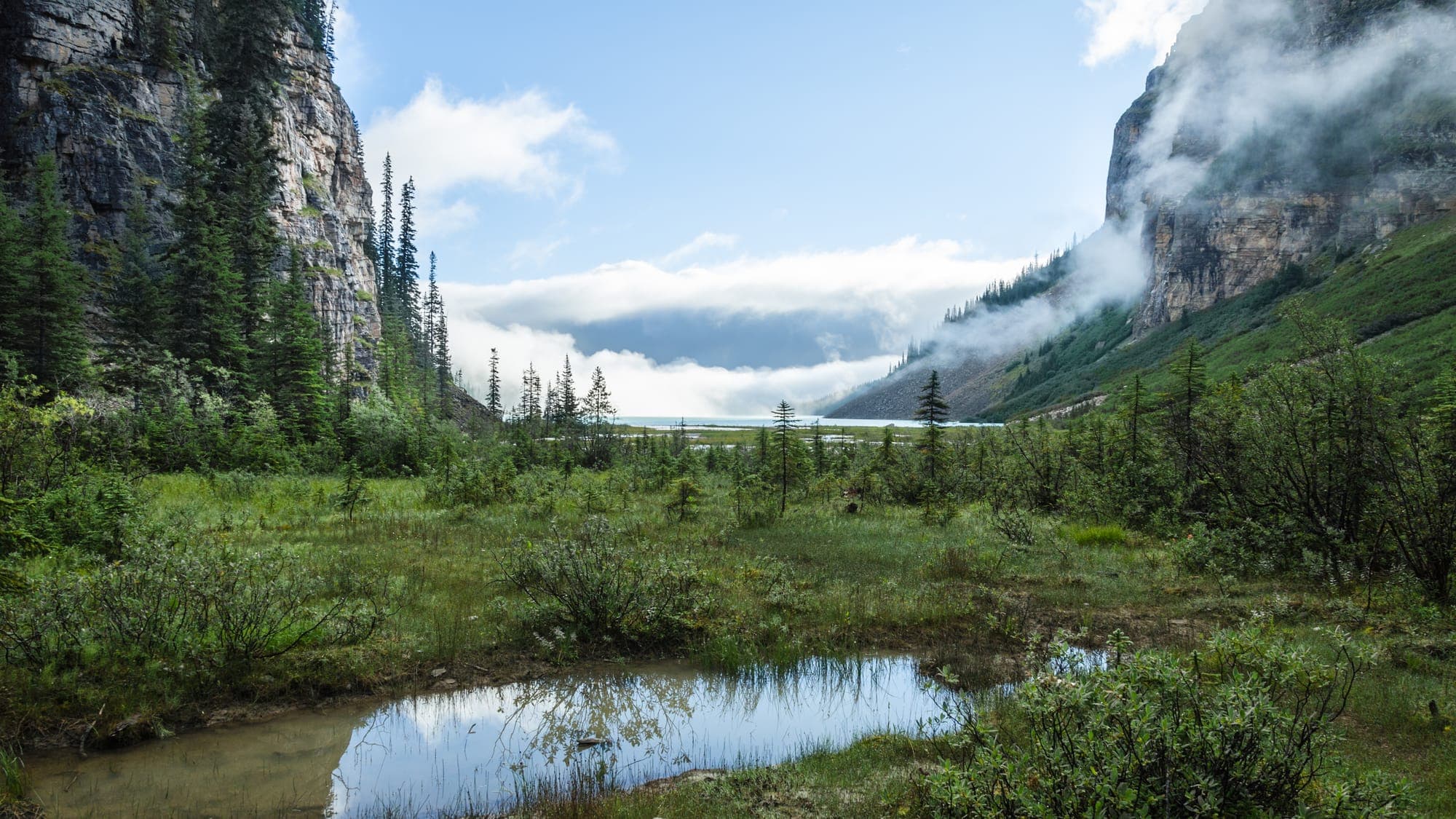
Lake Louise turns turquoise through June and holds its strongest colour in July and August. The colour is not a property of the lake itself but of what the summer pours into it: the Victoria Glacier grinds its bed into a powder called rock flour, the meltwater carries that silt in, and the suspended particles scatter blue-green light back out of the water.
That mechanism sets the calendar. The ice usually clears in late May, and the water it leaves behind is a flat grey-green, because the winter lake has had months to settle its silt out. As the melt picks up through June the flour arrives, the colour builds week by week, and by early July the lake looks the way it does in the photographs. It stays that way while the melt is strong, which is exactly the stretch of warm weather from July into early September.
When the nights start freezing again in September the melt slows, less flour comes in, and the colour softens — still plainly turquoise into early October, but quieter than midsummer. This is also why a May visit disappoints people who came for the colour, and why no time of day, filter or viewpoint will produce turquoise in a month when the melt has not started. The same glacial feed keeps the water near four degrees even in August, so the colour and the cold are one package.
When the lake freezes over
The surface usually starts to skin over in November, and the lake is white by Christmas. November ice is thin, unmeasured and dangerous — nobody maintains or checks it — so the honest freeze-up marker is the skating rink: the Fairmont Chateau Lake Louise clears and maintains a rink on the lake from roughly mid-December to mid-April, and once it is in, the frozen-lake version of Lake Louise is fully open for business.
At the other end, Parks Canada says the lake usually melts by late May, and in a cold spring the ice can hang on into early June. That means the lake spends roughly half the year frozen or part-frozen. If your dates are fixed and the white lake is the goal, January, February and early March are near certainties; mid-December and early April usually work; late April and May are melting and off limits to walk on. The details of the rink, skate rental and the ice castle are on the ice skating page.
.jpg)
Larch season, exact weeks
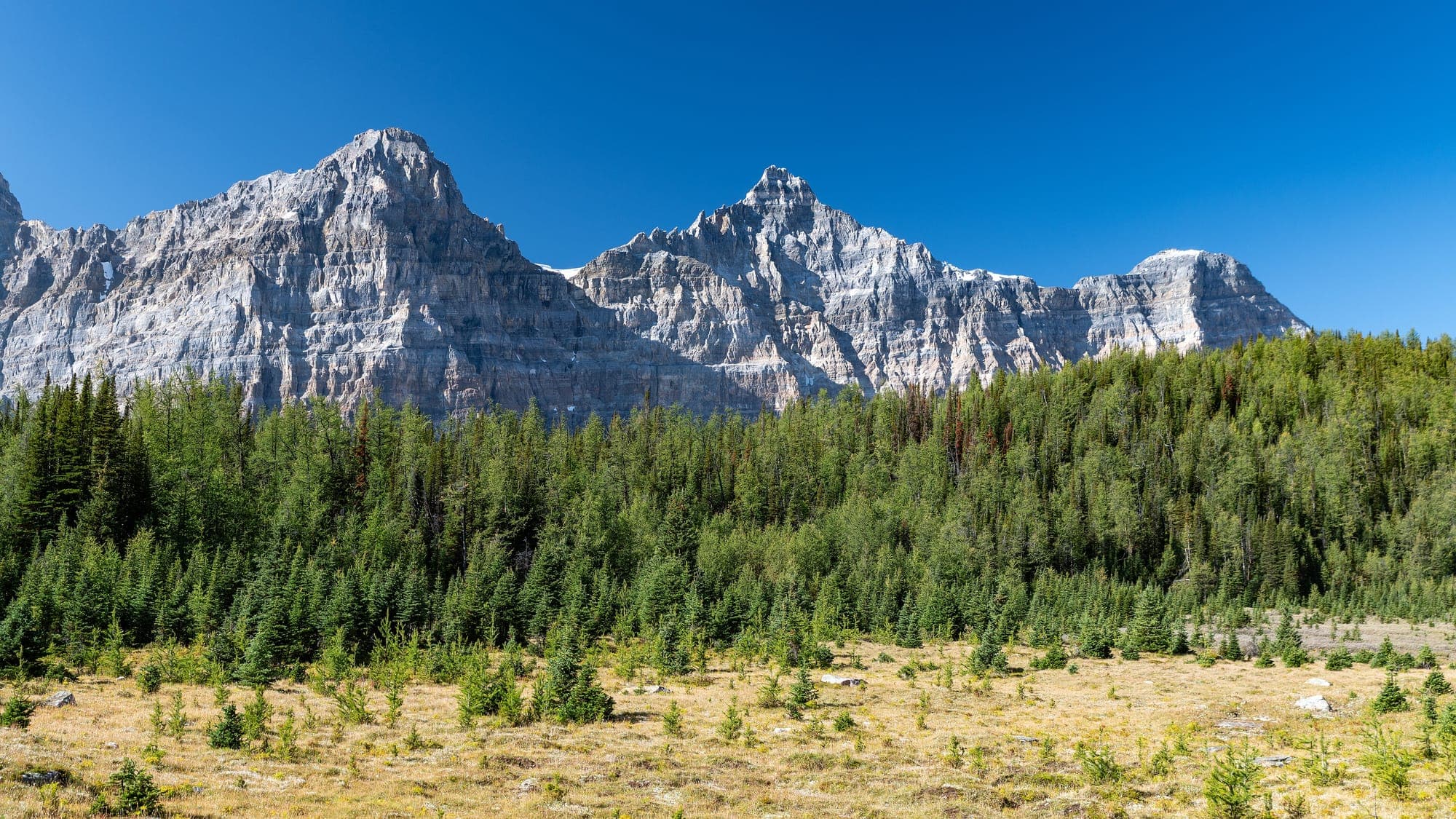
The larches usually start turning gold in the second week of September, peak in the third week, and are stripped bare by the first week of October. It is a short window, and a cold, windy week can end it early, so treat the third week of September as the target and anything later as a gamble.
Be clear about the geography, because it catches people out: the famous larch stands are not at Lake Louise. They are in Larch Valley, the hanging valley 570 metres above Moraine Lake, fourteen kilometres away — and Moraine Lake Road is closed to personal vehicles, so the hike starts with a shuttle seat. The full trail, timing and access details are on the Larch Valley and Sentinel Pass page.
Parks Canada lists the September larch weekends among the busiest days of the entire year, alongside Canada Day and the summer long weekends. The shuttle sells out immediately for those dates. Your realistic seat is the 60 percent of capacity released at 8 am Mountain Time two days before each travel day — set an alarm — and a Tuesday or Wednesday in the third week of September is a far better plan than any Saturday.
The best time of day, which matters more than the month
Arrive before sunrise or after six in the evening: the hour you show up changes your day more than the month you picked. Parks Canada states that the parking lots fill before sunrise and remain full until sunset in summer, so the difference between 5 am and 9 am is not a better or worse experience — it is whether you park at the lake at all.
Sunrise is around 5:30 am in midsummer and around 7:00 am in early September. The first Parks Canada shuttle leaves the Park and Ride at 6:30 am, which in June and July is after the sun is up — so seeing dawn at the lakeshore means driving in very early or booking a commercial sunrise tour. Note what dawn actually buys you here: still water and empty shoreline, not peak colour. The lakeshore sits in shade until mid-morning, and the turquoise reads strongest in full daylight.
That is why evening is the underrated answer. From about six the tour buses are gone, spaces open up, the light angles low across the Victoria Glacier, and the colour is still on. If you are building a full day around this, the hour-by-hour version is on the one-day itinerary.
How to avoid the crowds in July and August
Book the shuttle the moment seats are released, and keep your lakeshore hours before eight in the morning or after six in the evening. Those two decisions do more than everything else combined. The scale is worth knowing: Banff National Park recorded 4.28 million visitors in 2023, its busiest year on record, held near that level in 2024, and Parks Canada calls those its busiest seasons yet for the Lake Louise and Moraine Lake shuttles.
The mechanics: reservations for the 2026 season opened on 15 April 2026, when 40 percent of seats were released; the remaining 60 percent go live at 8 am Mountain Time two days before each travel day, which is your realistic chance in midsummer. No reservation? Roam Transit route 8X runs from Banff without one. How the whole system works is on the shuttle page, and what driving actually costs you is on the parking page.
Then use the calendar and your legs. Midweek runs meaningfully quieter than weekends, and Parks Canada names the pinch points to skip: Canada Day, Heritage Day at the start of August, and Labour Day. On the ground, the crowd is a two-hundred-metre phenomenon — it collapses with every minute of walking. Twenty minutes up the Lake Agnes trail, or past the far end of the shoreline path, the lakeshore scrum is gone even on a long weekend. And if none of this appeals, remember the honest fix: the same lake in late September midweek, or any clear morning in February, with almost nobody on it.
The cheapest months to come
The cheapest months are November to mid-December and January to mid-May, outside the Christmas and festival weeks — the fixed costs of a summer visit simply do not exist then. Lakeshore parking is free outside the paid season, no shuttle is needed because the lot has space, and rooms in the valley price against demand that is a fraction of August.
| Lakeshore parking, 15 May 2026 to 12 October 2026 | $42 per day |
|---|---|
| Lakeshore parking, rest of the year | free |
| Shuttle, adult, plus booking fee | $12.75 + $3.50 |
| Park entry, adult, per day | $12.25 |
| Park entry free window | 19 June to 7 September 2026 |
One 2026 wrinkle cuts the other way: Parks Canada is waiving daily park entry from 19 June to 7 September 2026 — which is generous, and lands precisely in the weeks when parking, shuttles and rooms are at their most expensive and the valley is at its fullest. Free entry does not make July cheap.
What the cheap months cost you instead is the postcard: no turquoise, short days, and outside the ski hill and the rink, not much open. The best value-for-experience trades are the edges — the last two weeks of September and the first week of October, when the colour is still on and summer pricing is easing, and February, when the frozen lake, the rink and the ski hill are all running and the valley is quiet on weekdays.
Common questions
What month is best to see Lake Louise?
How to avoid crowds at Lake Louise?
Is it better to go to Lake Louise in the morning or evening?
Is early December worth it?
When is Lake Louise turquoise?
Temperatures are the 1981–2010 Canadian Climate Normals for the Lake Louise station (climate ID 3053760), Environment and Climate Change Canada. Crowd periods, melt timing and tea house seasons come from Parks Canada: Lake Louise and Moraine Lake and the Banff National Park annual report. Fees and season dates come from parking information, the shuttle page and the fee schedule, verified 2026-08-10. Last checked 12 August 2026.