Lake Louise: elevation, depth and why it is that colour
The lake sits at 1,731 metres, about 5,679 feet. Its colour is ground-up rock from the Victoria Glacier. Its depth is a figure Parks Canada does not publish, so this page does not either.
Updated Mountain Time.
The lake today
The lake is normally open water at this time of year
The lake is normally open water and at its strongest colour, fed by glacial meltwater. This is the normal pattern for the date, not a measurement. Parks Canada says the lake usually melts by late May and publishes no freeze-up date.
How high is Lake Louise?
Lake Louise is 1,731 metres above sea level, about 5,679 feet. That figure is printed on Parks Canada's own area map for the lakeshore, and it is the one this site uses everywhere. Moraine Lake, fourteen kilometres away by road, is 1,884 metres.
| Lake Louise, the lakeshore | 1,731 m / 5,679 ft |
|---|---|
| Moraine Lake | 1,884 m / 6,181 ft |
| Tree line in Banff National Park | 2,000 m |
| Lake Louise village | not published by Parks Canada |
People search the elevation because they are worried about altitude. The shore is below the tree line, which Parks Canada puts at 2,000 metres, and the tea house walk to Lake Agnes climbs a few hundred metres above that. Parks Canada publishes no altitude-sickness guidance for the park. What the height does change is the weather.
How deep and how big is it?
Parks Canada does not publish a depth, a length, a width or a surface area for Lake Louise. Other websites print figures for all four; none of them come from the park, and this site does not repeat a number its operator has not published.
| Maximum depth | not published by Parks Canada |
|---|---|
| Length | not published by Parks Canada |
| Width | not published by Parks Canada |
| Surface area | not published by Parks Canada |
| Lakeshore trail, north shore, one way | 2.3 km |
The same applies to the claim that it is the deepest lake in the Rockies. Parks Canada does not rank its lakes by depth, so this page cannot say whether it is or not. What you can measure for yourself is the walk: the lakeshore trail runs the length of the north shore to the gravel flats at the far end, and Parks Canada gives it as 2.3 kilometres one way. That is the nearest thing to a published length the lake has.
Why is Lake Louise so blue?
The colour is rock flour: rock ground to powder by the Victoria Glacier and carried into the lake by its meltwater, where the particles stay suspended and scatter light. Parks Canada's glaciers page puts it plainly: glacial waters are often characterized for blue or green colours generated by the glacial till, or rock flour, they carry.
Because the colour comes from the melt, it follows the melt. Parks Canada says the lake usually melts by late May, and the water at break-up is grey-green rather than turquoise. The colour builds as the glacier sheds water through June and July, holds through late summer, and goes when the lake skins over. The same process, with more of the lake sitting under a wall of glaciers, gives Moraine Lake its deeper blue.

Is Lake Louise man-made?
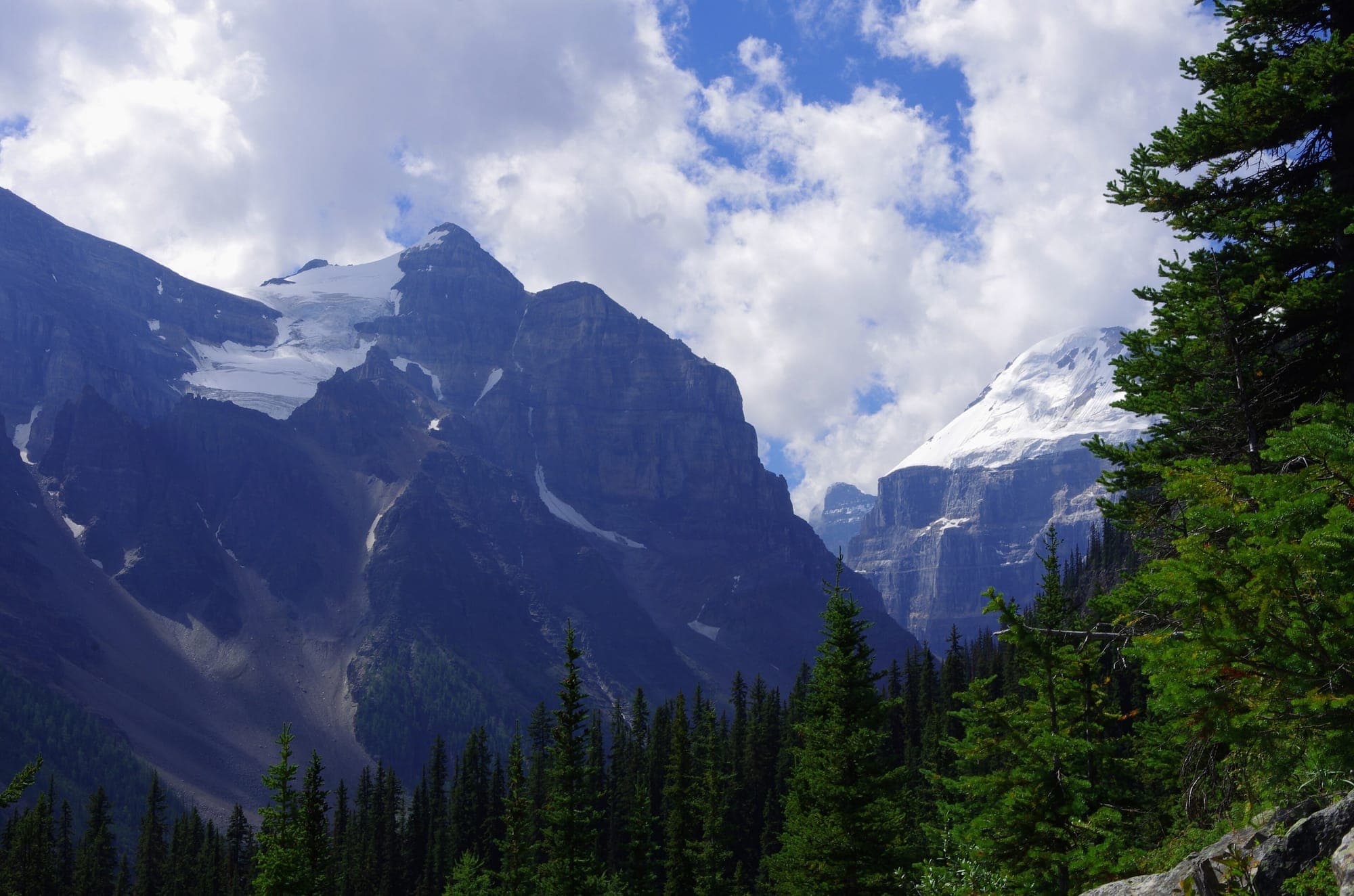
No. Lake Louise is a natural glacial lake, fed by meltwater from the Victoria Glacier at its far end. The built things on the shore are the hotel, the canoe dock and the path; the lake and its Stoney Nakoda name are older than all of them. The history page has that story.
Does Lake Louise have fish?
Yes. The Stoney Nakoda name for the lake, Horâ Juthin Îmne, means the Lake of the Little Fishes, and the fish are small because the water is cold and carries little food. Parks Canada does not list the species in Lake Louise by name; its regulations summary for Banff, Yoho and Kootenay identifies lake trout, westslope cutthroat trout, brook trout and bull trout as the fish an angler in these parks may meet.
| Season | 1 July to 1 November |
|---|---|
| Fish you may keep | 0: release everything |
| National park fishing permit, one day | $15 |
| National park fishing permit, one year | $51.25 |
| Park entry pass, adult, one day | $12.25 |
| Lake Agnes | closed to fishing |
| Bull trout | zero possession limit; release it |
A provincial licence is no use here; the permit is a national park one. Natural bait, scented lures and lead tackle under 50 grams are banned within 100 metres of any park water, felt-soled wading boots are banned everywhere, and fishing stops two hours after sunset. Parks Canada asks that every fish be released where it was caught, because whirling disease has been in the Bow River since 2016.
Can you drink the water?
Not straight from the lake. Parks Canada's instruction for every surface water in the park is the same: “Boil, filter or chemically treat all water before drinking. Surface water may be contaminated and unsafe for drinking.” Its paddling page adds that river water here carries glacial silt, fecal streptococci or giardia. The turquoise is rock powder in suspension, which is the reason the water looks clean and the reason it is not.
Bring your own. The village shops and the hotel sell water, and a filter or tablets are for the trail, not the shore.
Can you swim in it?
You can, and it is a plunge rather than a swim. Nothing forbids it, but Parks Canada says water temperature in the park seldom rises above 10°C, and a lake fed by a glacier sits at the cold end of that. There is no beach, no lifeguard and no changing room. The things to do page covers what people do at the water instead, and the canoe page the one way onto it.
When does it freeze?
Usually through November, and it stays frozen until the ice breaks up in late April and May. Parks Canada's only published date is that Lake Louise and Moraine Lake usually melt by late May; it gives no freeze-up date, so the winter side of the calendar is a pattern rather than a rule.
| December to March | normally frozen; skating loop cleared on the ice |
|---|---|
| April and May | ice breaking up; not safe to walk on |
| June to October | open water at its strongest colour |
| November | skinning over; ice not safe until Parks Canada says so |
| Parks Canada's melt date | Lake Louise and Moraine Lake usually melt by late May |
| Parks Canada's freeze date | not published by Parks Canada |
Today's state sits at the top of this page and on the conditions page. The skating page explains when the rink opens, and the winter page the rest of the season.
The name
The lake was Horâ Juthin Îmne to the Stoney Nakoda, then Emerald Lake to the railway surveyor shown it in 1882, and from 1884 Lake Louise, after Princess Louise Caroline Alberta, a daughter of Queen Victoria. The province took her name too. The sources for each step, and what came after, are on the history page.
Common questions
What is the elevation of Lake Louise in feet?
Can you get altitude sickness at Lake Louise?
How deep is Lake Louise?
Why is Lake Louise blue?
Are there fish in Lake Louise?
Is Lake Louise frozen right now?
Every figure on this page comes from Parks Canada: Lake Louise and Moraine Lake, the Lake Louise area map, glaciers and icefields, fishing in Banff, the 2026 fishing regulations summary, fees, paddling, backcountry and hiking. Where Parks Canada publishes no figure, the page says so. Last checked September 15, 2026.