Sunrise at Lake Louise
In midsummer the sun is up before 5:30 am and the car park is already full, yet the famous light on the glacier arrives later than the tables promise. When to set the alarm, and where to stand when it goes off.
Updated Mountain Time.
Sunrise this month
Sunrise 7:21 am today, sunset 7:57 pm
Computed for the lakeshore on Wednesday, September 16; the month's typical times are 7:20 am and 7:59 pm. Parks Canada says the lot fills by sunrise at this time of year, so the alarm matters as much as the forecast. Check the sky before you commit to it.
What time is sunrise at Lake Louise this month?
In mid-September the sun rises about 7:20 am and sets about 7:59 pm at Lake Louise. The whole year looks like this:
| January | 8:42 am / 5:05 pm |
|---|---|
| February | 7:57 am / 6:00 pm |
| March | 7:57 am / 7:49 pm |
| April | 6:48 am / 8:41 pm |
| May | 5:52 am / 9:29 pm |
| June | 5:27 am / 10:03 pm |
| July | 5:46 am / 9:55 pm |
| August | 6:31 am / 9:07 pm |
| September | 7:20 am / 7:59 pm |
| October | 8:09 am / 6:51 pm |
| November | 8:03 am / 4:55 pm |
| December | 8:43 am / 4:36 pm |
The swing through the year is enormous, because Lake Louise sits at 51 degrees north. Around the June solstice the sun is up for more than sixteen and a half hours, rising about 5:30 am and setting a few minutes after 10 pm. Around the December solstice it manages barely eight, rising close to 8:45 am and setting before 4:45 pm. A June sunrise is a genuinely brutal alarm; a December one happens after a leisurely breakfast.
Two quirks in the table are worth knowing about. March's sunrise looks no earlier than February's because the clocks jump forward in early March and take an hour of morning with them. And the printed minute is not when the show starts: the sky begins to brighten roughly 35 to 45 minutes before sunrise, a little more around midsummer. That civil twilight is the working window for photographers, and, as the next section explains, at this particular lake it matters more than the sunrise itself.
If you can pick your month, remember the water has a season of its own. The lake is normally frozen from November into May, and the ice breaks up through late April and May, so the turquoise-and-reflection version of sunrise really exists from about June to October. The colour comes from glacial meltwater and is at its strongest in high summer. June buys the longest evenings and the cruellest alarm; September trades a little of the colour for a 7:20 am start and a thinner crowd; October mornings are cold, quiet and often frosted. There is no wrong answer, only different alarms.
When does the light actually reach the lake?
Well after the printed time. Sunrise tables assume a flat horizon, and Lake Louise sits in a mountain bowl without one, so treat the table above as when the show starts on the summits, not on the water.
The geometry does the explaining. From the lakeshore you look southwest, straight down the lake at Mount Victoria and the Victoria Glacier. The sun comes up behind you, over the ranges across the Bow Valley, and the first things it can reach are the summits at the head of the lake, because they stand high enough to see over the ridges that still shade everything else. The tops catch their first colour close to the printed minute. The glow then has to walk down the headwall, and that is the slow part: the glacier itself usually waits somewhere between half an hour and an hour after nominal sunrise, and the water below it longer still. The lower the sun's track, the slower it climbs, so in spring and autumn everything stretches further than in June.
A clear summer morning runs in that order. In the twilight before sunrise the lake is often at its calmest, and the pink sky doubles in the water — for many people the best picture of the day happens before the sun has officially risen at all. Then the summit of Mount Victoria turns orange, the line of light slides down the glacier over the next hour, and the water itself sits in cold blue shade the whole time, which is exactly the contrast the famous photographs are made of. Being twenty minutes late does not ruin the morning, because the main event is that slow descent of light. Being an hour early is what buys you the still water, and the first breath of wind takes the reflection away.
None of this survives cloud on the eastern horizon, and a mountain forecast is a suggestion rather than a promise. Before you commit to a 4 am alarm, look at the forecast and at the webcams, which show you exactly this light on previous mornings. In winter the sequence still happens, but it lands on a frozen white lake rather than a reflecting one — the ice is normally in place from November into May.
What time should I leave Banff or Canmore?
Leave Banff about an hour and three-quarters before the sunrise time in the table, and Canmore a bit over two hours before. That is the drive plus the margin that actually gets you a parking space and a spot on the shore in the twilight.
The arithmetic: Lake Louise is 55 kilometres west of the Town of Banff on the Trans-Canada, which is Parks Canada's own figure. Allow about 45 minutes in the dark, including the short climb from the village up to the lake. Canmore adds roughly another 25 kilometres east of Banff, so call it 80 kilometres and a bit over an hour. Then put yourself in the lot 45 minutes to an hour before the printed sunrise, for the reasons the parking section explains.
Worked through, mid-June's 5:27 am sunrise means being parked by about 4:30 am, leaving Banff around 3:45 am and Canmore around 3:20 am. By mid-September the same plan starts at a friendlier 5:45 am in Banff. From late October onward sunrise is after 8 am and the whole exercise becomes civilised.
Three practical notes for the drive. Nothing is open at that hour, so sort out fuel the night before and bring your own coffee. Watch for animals on the highway in the dark and drive to your headlights, not the speed limit. And dress for a freezer: dawn at the lake is cold in every month of the year, including July, and standing still on a shoreline for an hour is far colder than hiking.
Sleeping closer shortens all of it. A bed in Lake Louise village puts you a few minutes' drive from the lot instead of forty-five, and the Chateau is the one hotel standing on the shore itself, where sunrise is a walk out of the lobby rather than a drive. Both book out far ahead in summer — the same scarcity that fills the car park fills the beds — but for a trip built around this one morning, the night in the village is the single biggest upgrade you can buy.
Will I get a parking space at that hour?
Yes — provided you beat the sunrise itself, not just the crowds. Parks Canada's own words are that the lakeshore lot fills by sunrise and stays full throughout daylight hours in the summer months, which makes the table at the top of this page effectively the lot's closing time.
| Lakeshore parking, per vehicle per day | $42 |
|---|---|
| Paid season | 15 May 2026 to 12 October 2026 |
| Park entry, per adult per day | $12.25 |
| Park entry, per family or group | $24.50 |
| First regular Parks Canada shuttle | 6:30 am |
The fee is a flat $42 for the day, so arriving at 4:30 am costs exactly the same as arriving at noon. The difference is that at 4:30 am there is a space. Pay at the machines in the lot, and remember the park entry pass is a separate charge on top. Outside the paid season, which runs 15 May 2026 to 12 October 2026, the lot is free and a dawn space is never in doubt.
The shuttle cannot rescue you from the early start. The first regular departure leaves the Park and Ride at 6:30 am, and from May until the middle of August the sun is already up before that bus moves. In summer, driving early is the realistic way to see sunrise at Lake Louise; the shuttle is the answer for every other hour of the day. The full parking story, including what to do when the lot is full, is on the parking page.

Where should I stand for the classic shot?
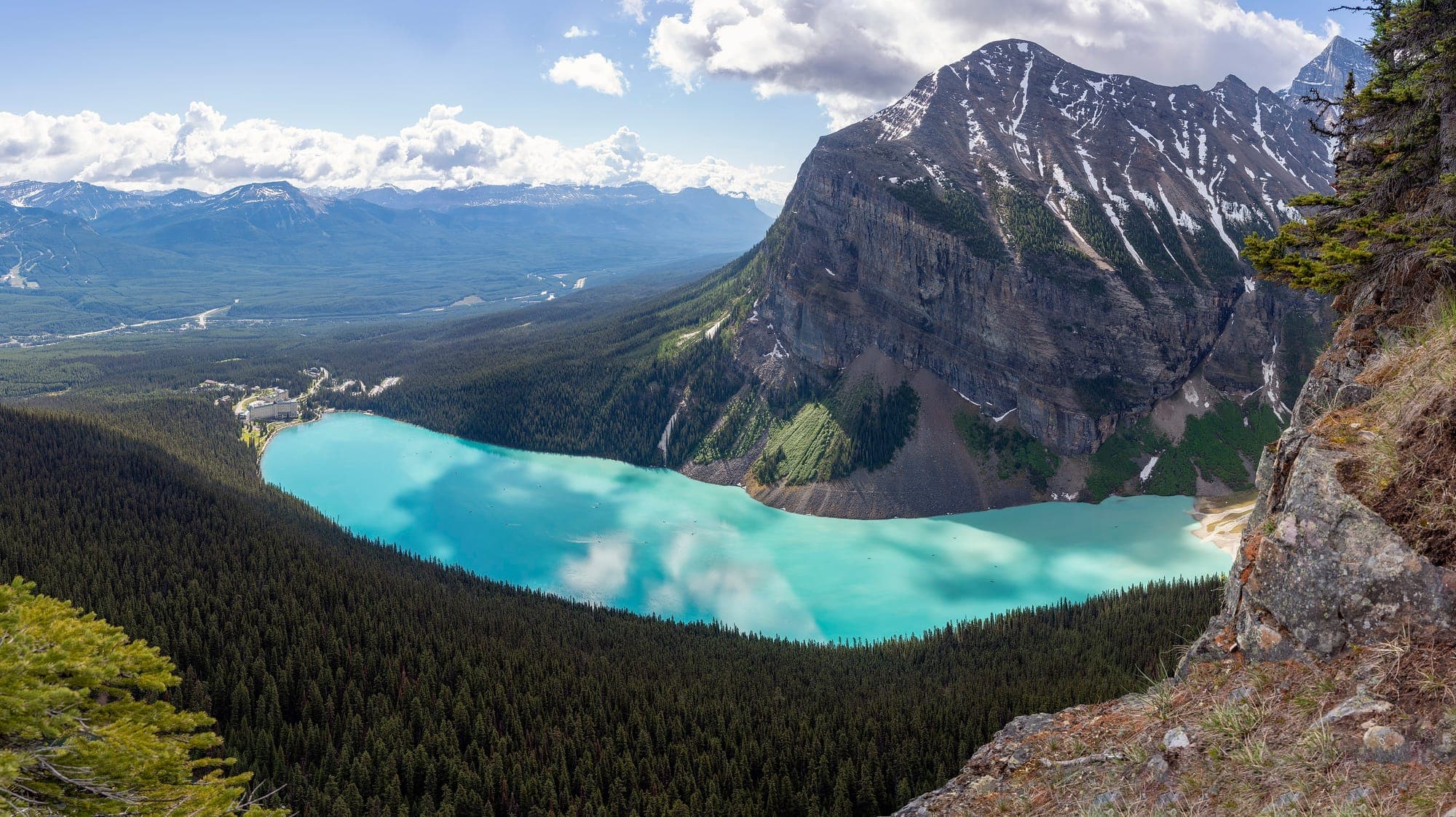
On the lakeshore path in front of the Chateau, looking straight down the lake at Mount Victoria and the Victoria Glacier. It is a few minutes of flat walking from the car park, it costs nothing beyond parking and park entry, and it is the exact view on the postcards. At dawn the far end of the lake catches the light while the shore around you stays in shade, so the classic composition mostly arranges itself.
The crowd concentrates in the first two hundred metres, around the canoe docks and the boathouse. Keep walking. The lakeshore trail runs the length of the lake along the northwest shore — the only shore with a trail — and the view down the lake barely changes while the people thin out with every minute you walk. The canoes and the boathouse make a good near foreground from the Chateau end; further along, the shoreline rocks and leaning trees do the same job with nobody in the frame.
Do not expect solitude in summer. On a fine July or August morning a row of tripods is set up before first light, and the benches nearest the Chateau are taken in the dark. It never feels crowded the way midday does — the lot only holds so many cars, and dawn people are quiet people — but if you want a stretch of shore to yourself, the answer is the same as everywhere at Lake Louise: keep walking for ten minutes.
If you want height, Fairview Lookout is the short option: 1.2 kilometres and about 45 minutes there and back, looking down on the lake and the Chateau together. It is a forest trail, so save it for after the light has spread rather than climbing it in the dark. The Big Beehive has the definitive elevated view, straight down the full length of the lake, but it sits above Lake Agnes and costs four to five hours and the hardest sustained climb at Lake Louise — a plan for the rest of the morning, not for dawn.
In winter the same spot works at a kinder hour. The lake is normally frozen and white from November into May, sunrise waits until after 8 am, parking is free, and the glow on the headwall happens just the same — you trade the reflection for solitude and squeaking snow.
Should I do sunrise at Moraine Lake instead?
You cannot drive there — Moraine Lake Road is closed to personal vehicles year round — but Parks Canada runs an Alpine Start shuttle at 4 am and 5 am precisely for this, so a Moraine Lake sunrise is very much still possible.
The Alpine Start runs daily from 1 June to 12 October 2026 and departs from the Lake Louise lakeshore car park, so the plan begins with exactly the same early drive to exactly the same lot as a Lake Louise sunrise, with the lakeshore parking fee on top and proof of payment checked before you board. The fare is the same as the regular shuttle, $12.75 for an adult plus the $3.50 online booking fee, reserved through the Parks Canada system. You come back on the Lake Connector, which starts running at 7 am, and your ticket lets you see both lakes in one morning.
If the Alpine Start seats are gone, the two remaining pre-dawn routes are a licensed commercial sunrise tour, which does not need a Parks Canada reservation, or cycling the road, which is free and entirely on your own legs. The full picture of Moraine access is on the Moraine Lake page.
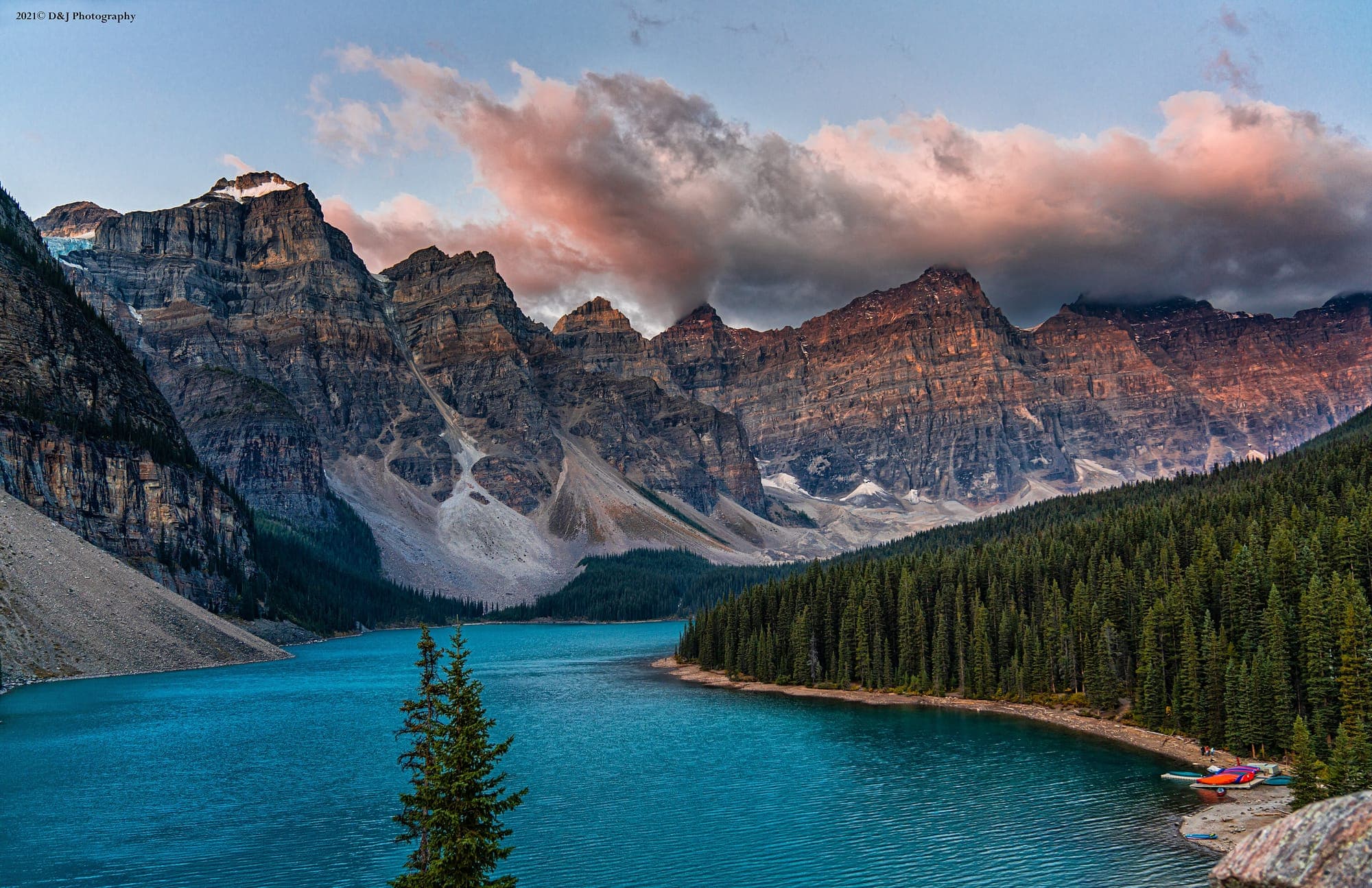
As for which lake deserves your one dawn: Moraine's sunrise, with first light hitting the Valley of the Ten Peaks, is probably the more photographed of the two, and both lakes face the morning light the same way. Lake Louise asks nothing but an early drive; Moraine adds a shuttle booking that sells out. If you failed to plan, Lake Louise is the sunrise you can still have tomorrow.
.jpg)
Common questions
Is it better to go to Lake Louise in the morning or evening?
What time should I get to Lake Louise for sunrise?
Does the sun rise over the lake or behind you?
Is sunset at Lake Louise worth staying for?
Sun times are computed for the lake at 51.43° N, 116.18° W and checked against the United States Naval Observatory. Parking, shuttle and Alpine Start facts come from Parks Canada: parking information, shuttle information and the fee schedule. Last checked 12 August 2026.