Canoe Rental on Lake Louise: Price, Hours and Season
A canoe costs $180 an hour plus GST in 2026, or $110 if you are sleeping at the Chateau. Here is how the queue works, when the boathouse actually opens, and when Moraine Lake is the better call.
Updated Mountain Time.
Canoe status today: open, closed, or iced over
The boathouse should be open today
Rentals run daily from 8:30 am to 8:00 pm through the summer, first come, first served. In July and August expect a queue through the middle of the day; the wait is shortest at opening and after about 5 pm.
What it costs per hour in 2026
A canoe costs $180 plus GST for one hour if you are a day visitor, or $110 plus GST if you are staying at the Fairmont Chateau Lake Louise. Both rates also come in a half-hour version, and the price is per canoe rather than per person.
| Day visitor, one hour | $180 + GST |
|---|---|
| Day visitor, half hour | $160 + GST |
| Fairmont guest, one hour | $110 + GST |
| Fairmont guest, half hour | $100 + GST |
| Capacity per canoe | 3 adults, or 2 adults + 2 small children |
GST in Alberta is 5 percent, so the card is actually charged $189 for a visitor hour and $115.50 for a guest hour. The boathouse takes debit and credit cards only, no cash, and hotel guests can charge the rental to their room. Each canoe holds three adults, or two adults aged 16 or older plus two children who each weigh under 55 pounds, so a full boat brings the visitor hour down to $63 a head with the tax included.
Budget for the rest of the trip too, because the canoe is never the only cost. Everyone entering the park needs an entry pass, which is $12.25 a day for an adult or $24.50 for a family, and if you drive to the lake between 15 May and 12 October the lakeshore lot costs another $42 for the day. Two adults arriving by car in August are realistically in for about $250 by the time the paddle starts.
Is the hour enough? Yes, comfortably. Lake Louise is about two kilometres long, and an hour lets you paddle to the far end below the Victoria Glacier and come back without racing. The half hour is for photographs near the dock, not for seeing the lake.
Opening hours and the season dates
The boathouse operates daily from 8:30 am to 8:00 pm in season, and the Fairmont does not publish fixed opening and closing dates for the year. It opens when the ice is fully off the lake, which is usually late May or early June, and it shuts down in early October or whenever snow and cold end the season, whichever comes first.
That vagueness is honest rather than lazy. The lake is frozen for roughly half the year, the thaw date moves by weeks from one spring to the next, and an early autumn storm can end the season overnight. If your trip is in June or October, treat the boathouse as a maybe: check the Fairmont canoeing page or ask the hotel directly, and look at the webcams before you commit a morning to it. From July through September you can simply show up.
One quirk worth knowing: the famous turquoise arrives with the glacial melt, so an early June paddle happens on water that is clearer and greener than the postcards. The colour peaks through July and August, which is also exactly when the queue peaks. An evening paddle in that window, after the day trippers thin out, is the best version of this whole experience: the boathouse runs until 8:00 pm, and the light on the Victoria Glacier is better at 7 pm than at noon anyway.
The water is also calmest early. Like most mountain lakes, Lake Louise tends to sit glassy through the morning and pick up a breeze by early afternoon, which turns the mirror reflections into chop. That matters twice: flat water makes the photographs everyone came for, and it makes the paddling much easier if half your boat is children. If the surface matters to you, the 8:30 am queue is the one to stand in.

Where the boathouse is and how the queue works
The boathouse sits on the lakeshore beside the Fairmont Chateau Lake Louise, about five minutes on foot from the lakeshore parking lot, and rentals are strictly first come, first served. There are no reservations, no online booking, and no way to hold a canoe by phone; you stand in the line and wait for a boat to come back.
From the parking lot, walk toward the lake and the Chateau, and the boathouse is on the shore by the hotel with the canoe racks in plain view. You cannot miss it, because in July there is a queue snaking away from it. The line moves in a rolling fashion, since canoes go out for an hour and come back staggered, but on a fine midsummer day the midday wait is long enough that you should plan around it rather than through it. Arrive for the 8:30 am opening, or come after 5 pm, and the queue is short or absent.
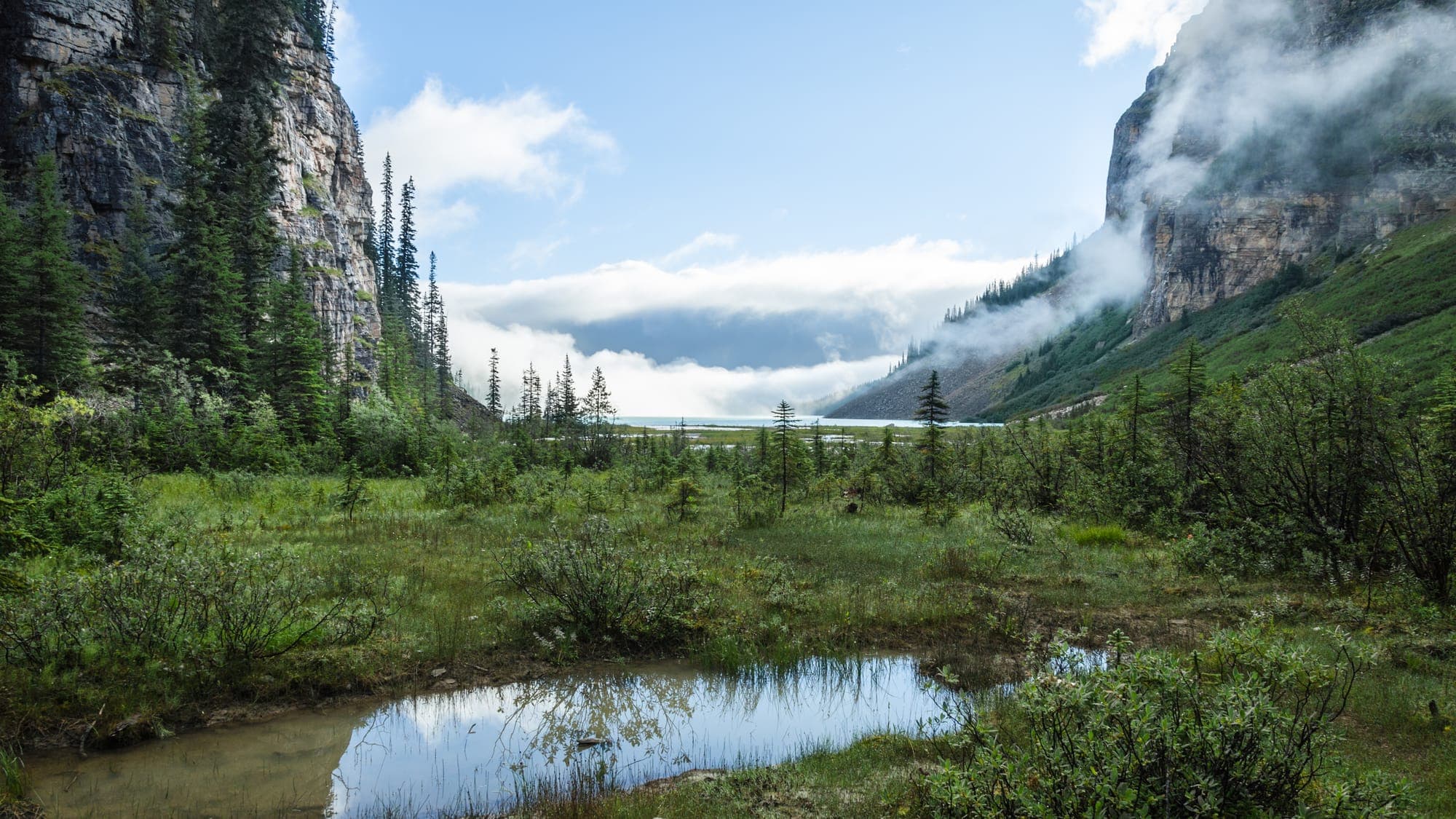
Once you are on the water, the route plans itself. Almost every boat heads up the lake toward the glacier, with Fairview Mountain rising on the left and the Big Beehive on the right. The far end is shallower where the glacial stream comes in, milky with rock flour, and the Chateau behind you shrinks to toy scale, which is the one photograph nobody gets from shore. Leave a margin for the return leg; paddling back into an afternoon breeze is slower than the way out, and the rental clock does not care.
Dress for the lake rather than the parking lot. It is noticeably cooler in the middle of the water than on the shore path, the breeze comes off a glacier, and an hour is long enough to regret a T-shirt. Bring a layer even in August, and either strap the phone to your wrist or accept the risk: the lake is roughly 70 metres deep and keeps what it is given.
In summer, getting to the lake at all is the harder queue. The lakeshore lot fills by sunrise and stays full through daylight hours, so an on-the-water-at-opening plan means either parking before dawn or taking the Parks Canada shuttle from the Park and Ride, which costs $12.75 for an adult and starts running at 6:30 am. Either way, do not plan a midday arrival in August and expect to walk straight onto a canoe. The people paddling at 9 am planned their morning around the boathouse; the people in the long queue did not.
Guests of the Fairmont versus day visitors
Guests of the Chateau pay $110 an hour against the day visitor's $180, and they can charge the rental to their room. The $70-an-hour gap is one of the few genuinely valuable perks of staying at the hotel, and it stacks with the bigger one: guests are already standing at the lake at 8:30 am without having fought for parking or a shuttle seat.
Both groups stand in the same first-come line and paddle the same canoes. There is no guest-only fleet and no published priority lane, so the guest advantage is price and position, not queue jumping. If you are staying at the Chateau, the obvious move is a paddle at opening or in the last hours before 8:00 pm, when day visitors have mostly gone.
The Fairmont also runs a guided option out of the same boathouse: the Voyageur canoe, a 26-foot cedar-strip freight canoe that takes a whole group out with a guide who handles the steering and the stories. Pricing and times are not published on the boathouse page, so ask the hotel directly if a guided paddle appeals more than renting your own boat.
Bringing your own boat, and whether you can kayak
You can launch your own canoe, kayak or paddleboard on Lake Louise for free, but you must complete Parks Canada's aquatic invasive species self-certification permit before it touches the water. The permit costs nothing and takes minutes, online or at a visitor centre, and it is you attesting that your boat and gear have been cleaned, drained and dried.
The drying rules have teeth. Gear last used in British Columbia, Alberta, Yukon or the Northwest Territories must be dry for at least 48 hours before it goes into any water in the park; gear from anywhere else must be dry for 30 days. The point is whirling disease and invasive mussels, both of which travel in the film of water a boat carries between lakes, and Parks Canada does check. The permit covers more than the boat itself: paddles, life jackets, wetsuits, water toys and fishing gear all count as water-related equipment under the same rule. You can complete it online through Parks Canada or at a visitor centre, and every person on the water needs a personal flotation device, rental or not.
Bringing your own boat is also the only way to kayak Lake Louise, because the boathouse rents canoes and nothing else. No kayaks, no paddleboards. Motors are not part of the picture either way; motorized boating in Banff National Park is limited to Lake Minnewanka, so everything on Lake Louise moves by paddle. The practical catch is the one that runs through every summer plan here: a boat on the roof means driving, the lakeshore lot fills by sunrise, and a canoe does not fit on the shuttle. Own-boat paddling on Lake Louise in July is a dawn activity or it does not happen.

Canoeing Lake Louise or Moraine Lake: which is better
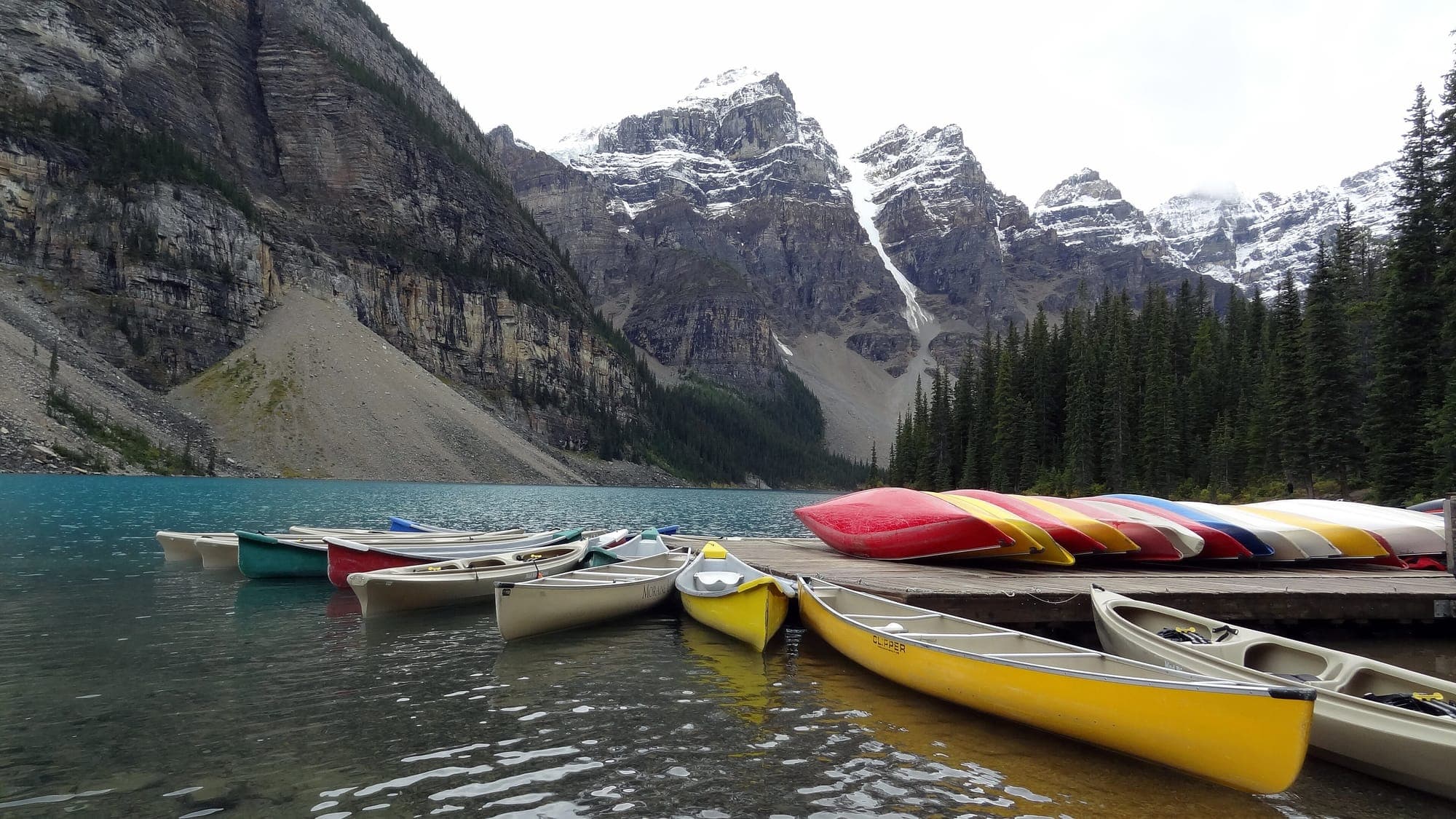
Moraine Lake is the more dramatic paddle; Lake Louise is the one that is easier to actually pull off. If you can only rent once and everything goes your way, Moraine Lake under the Valley of the Ten Peaks wins on scenery, and at $170 plus tax an hour it is slightly cheaper than the Lake Louise visitor rate too.
The catch is everything around the paddle. Moraine Lake Road is closed to personal vehicles, so you arrive by shuttle or bus on someone else's timetable. The canoe dock there, run by Moraine Lake Lodge, operates roughly mid-June to mid-September, takes no reservations, and shuts down without notice when snow, rain or wind move in. Each canoe takes two or three people, and paddles and life jackets come with it, same as at Lake Louise.
Lake Louise gives you a longer season, 8:30 am to 8:00 pm hours that make an evening paddle possible, and at least the theoretical option of arriving in your own car. If you are staying at the Chateau, the discounted guest rate settles the question by itself. A reasonable rule: canoe wherever your day already puts you, because a Moraine Lake shuttle trip booked around a rental that cancels for weather is a worse morning than a certain paddle on Lake Louise. Doing both in one trip is entirely possible outside peak season and a stretch in August.
Can you swim in the lake?
You can, in the sense that nothing forbids it, but Lake Louise is glacier fed and Parks Canada notes that water temperatures in the park seldom rise above 10°C. That is cold-plunge territory on the hottest day of August, and it is why the same agency warns that a capsize here can end in hypothermia.
On warm afternoons you will see people wade off the shore near the boathouse and a few do brief, loud plunges. Fine, as long as it stays brief: a minute or two in water that cold is a shock the body handles, while a swim across open water is genuinely dangerous, and there are no lifeguards anywhere on the lake. If you tip a canoe, get back to it, stay with it, and get out of the water fast rather than trying to swim gear ashore. The lake is beautiful precisely because it is mostly melted glacier; it makes no exceptions for swimmers.
Common questions
Is canoeing on Lake Louise worth it?
How much does it cost to rent a canoe at Lake Louise?
What time can you rent a canoe at Lake Louise?
Can you kayak on Lake Louise?
Should I canoe on Lake Louise or Moraine Lake?
Can you swim in Lake Louise?
Canoe prices, hours and capacity on this page come from the Fairmont Chateau Lake Louise: the Boathouse and canoeing and canoe rentals. Own-boat rules and water temperature come from Parks Canada: paddling in Banff National Park. Moraine Lake figures come from Moraine Lake Lodge, and park entry and parking fees from the Parks Canada fee schedule. Last checked 12 August 2026.